 Technology
Industrial Automation Explained: How Smart Factories Operate in 2026

Sunil Kumar Uikey
Founder & Editor-in-Chief
A comprehensive guide to industrial automation explained. Discover how smart factories operate in 2026, Industry 4.0 technologies, and the future of manufacturing.

Introduction
As we progress through the mid-2020s, the global manufacturing sector is undergoing an unprecedented transformation. Traditional factories, once characterized by manual labor, isolated machinery, and reactive maintenance, are rapidly evolving into hyper-connected, intelligent ecosystems. If you want to understand the future of production, you need to look at industrial automation explained in the context of today's technological capabilities. The intersection of artificial intelligence, high-speed connectivity, and advanced robotics has completely rewritten the rulebook on how physical goods are created.
In 2026, manufacturing is becoming increasingly intelligent and automated out of sheer necessity. Global supply chain disruptions, severe labor shortages, and an ever-growing demand for sustainable, high-precision products have forced companies to rethink their entire operational strategies. Industrial automation is no longer a futuristic concept or a luxury reserved for the world's wealthiest conglomerates; it is a baseline requirement for survival in a highly competitive global market.
In this comprehensive, beginner-friendly guide, we will break down exactly what industrial automation technology is, how modern smart factories operate, the core components driving Industry 4.0, and what the future of manufacturing realistically looks like over the next decade.
Quick Answer
What is Industrial Automation? Industrial automation is the integration of robotics, AI, and IoT sensors to operate manufacturing processes with minimal human intervention. Powered by Industry 4.0, smart factories utilize Programmable Logic Controllers (PLCs), machine vision, and edge computing to automatically monitor, optimize, and execute physical production runs, radically improving efficiency and safety across the global manufacturing landscape.
Key Takeaways
- Beyond Basic Mechanization: Industrial automation goes beyond simple assembly line robots; it involves a holistic, interconnected ecosystem where physical machines communicate with digital intelligence to optimize entire production runs autonomously.
- Data is the New Electricity: Modern smart factories rely on continuous data streams from millions of IoT sensors, allowing operators to monitor, analyze, and optimize operations in real-time.
- Predictive, Not Reactive: Instead of waiting for a machine to break down, advanced industrial automation uses predictive maintenance algorithms to identify potential failures weeks before they happen.
- Human-Robot Collaboration: The automation narrative has shifted from "replacing humans" to "augmenting humans." The factory floor of 2026 is defined by collaborative robots safely working alongside human technicians.
- The Backbone of Industry 4.0: The seamless integration of digital and physical systems—powered by artificial intelligence, cloud computing, and advanced networking—forms the foundation of the Fourth Industrial Revolution.
What Is Industrial Automation?
To begin answering what is industrial automation, we must define it in the context of modern industry. At its most fundamental level, industrial automation refers to the use of advanced control systems, software, and technologies (such as robots, computers, and information technologies) to handle different processes and machinery in an industry with minimal human intervention.
In the past, automation simply meant mechanization—using a machine to help a human lift a heavy object. Today, industrial automation involves a vast network of highly sophisticated systems capable of making independent decisions. It is the delegation of both physical exertion and routine cognitive tasks to machines.
When you look at smart factories explained, you are looking at facilities where the entire production lifecycle is automated. The system knows exactly how much raw material to order, when to schedule maintenance, how to route components across the factory floor, and how to rigorously inspect the final product for microscopic defects—all orchestrated by centralized software.
Consumer Automation vs Industrial Automation
While the underlying technologies (sensors, processors, algorithms) might seem similar, the applications of consumer and industrial automation are vastly different.
| Consumer Automation | Industrial Automation |
|---|---|
| Robot Vacuum | Autonomous Guided Vehicle (AGV) |
| Smart Home | Smart Factory |
| Smart Plug | Programmable Logic Controller (PLC) |
| Alexa / Voice Assistant | Manufacturing Dashboard (HMI/SCADA) |
| Home Security Camera | Machine Vision / Optical Inspection |
Industrial systems require a fundamentally different tier of engineering. While a consumer smart plug failing is a minor inconvenience, a PLC failing in an automotive plant can cost tens of thousands of dollars per minute in downtime and pose a severe physical danger to human operators. Industrial systems prioritize extreme reliability, microscopic precision, rigorous safety compliance, and continuous 24/7 uptime.
How Industrial Systems Are Organized
To understand how a massive factory communicates from the boardroom down to the robotic arms, we rely on established architectural frameworks designed by the International Society of Automation (ISA).
The ISA-95 Framework and Purdue Model
The Purdue Enterprise Reference Architecture (Purdue Model), formalized by ISA-95, is the globally recognized standard for integrating enterprise IT (Information Technology) and factory OT (Operational Technology) systems.
It organizes a factory into a strict hierarchy:
- Level 5 (Enterprise): The corporate network where broad strategic decisions are made.
- Level 4 (Business Systems): Where ERP (Enterprise Resource Planning) software manages logistics, supply chain, and global inventory.
- Level 3 (Manufacturing Operations): Where the MES (Manufacturing Execution System) tracks the physical production of products, managing workflows, recipes, and shift schedules.
- Level 2 (Supervisory Control): Where SCADA (Supervisory Control and Data Acquisition) systems monitor the real-time status of the factory floor, collecting data from various controllers.
- Level 1 (Basic Control): The domain of PLCs (Programmable Logic Controllers) driving the physical automation.
- Level 0 (Physical Process): The actual factory floor containing the physical sensors, actuators, robotics, and robotic arms.
This hierarchy ensures that high-level business goals seamlessly translate down into microscopic mechanical actions, all while keeping the critical lower levels secure from external network interference.
How Industrial Automation Works (The Architecture)
Following the ISA-95 model, a modern smart factory operates via a top-down architectural flow of data and commands, orchestrated by an extensive AI infrastructure.
Industrial Automation Architecture Diagram
         [Business Goals]
                │
                ▼
  [Enterprise Resource Planning (ERP)]
                │
                ▼
[Manufacturing Execution System (MES)]
                │
                ▼
             [SCADA]
                │
                ▼
[Programmable Logic Controllers (PLC)]
                │
                ▼
         [Robots & Machines]
                │
                ▼
       [Sensors & Actuators]
At Level 0 and Level 1, the physical work occurs:
- Sensors: Devices that capture physical data (temperature, pressure, optical proximity).
- PLCs (Programmable Logic Controllers): Rugged industrial computers from vendors like Siemens, Rockwell Automation, and Beckhoff. They run logic code in milliseconds, reading sensors and dictating the precise timing of the assembly line.
- Robotics: Multi-axis mechanical arms from leaders like FANUC, Yaskawa, ABB, and Universal Robots executing physical tasks.
- Machine Vision: High-speed industrial cameras ensuring quality control. For a deep dive, see our guide on machine vision explained.
The Industrial Automation Technology Ecosystem
How does automation fit into the broader landscape of modern technology? It acts as the physical nexus where digital intelligence meets the real world.
         [Cloud Computing]
                 │
                 ▼
         [Edge Computing]
                 │
                 ▼
      [Industrial IoT (IIoT)]
                 │
                 ▼
      [Industrial Automation]
                 │
                 ▼
         [Machine Vision]
                 │
                 ▼
            [Robotics]
                 │
                 ▼
          [Digital Twins]
- Cloud Computing handles massive, long-term data storage and macroscopic analytics.
- Edge Computing places powerful servers directly on the factory floor, allowing for instant, zero-latency decisions critical for high-speed robotics. See edge computing explained.
- IIoT is the vast network of connected sensors communicating via robust industrial protocols. See what is IoT.
- Digital Twins are exact, highly complex virtual replicas of the physical factory, used for simulation. Explore digital twins explained.
The Automation Maturity Journey
Transitioning a traditional factory into an Industry 4.0 powerhouse does not happen overnight. Executives view automation through a maturity model:
       [Manual]
          │
          ▼
     [Mechanized]
          │
          ▼
     [Automated]
          │
          ▼
     [Connected]
          │
          ▼
     [Predictive]
          │
          ▼
     [Autonomous]
- Manual: Pure human physical labor.
- Mechanized: Humans using machines to amplify force (e.g., a motorized hoist).
- Automated: Machines performing repetitive tasks based on rigid programming (e.g., early automotive assembly lines).
- Connected (Industry 4.0 begins): Machines sharing data via IIoT and standards like OPC UA, providing centralized visibility to managers.
- Predictive: AI analyzing the connected data to predict machine failures before they occur.
- Autonomous: The ultimate goal. The factory dynamically self-optimizes, reroutes logistics, and adjusts production schedules with minimal human intervention.
Best Practices for Deploying Industrial Automation
Successfully implementing an industrial vision system or automated production line requires meticulous planning. Adhere to these proven best practices:
- OT Cybersecurity: Operational Technology (OT) networks must be vigorously defended. Adhere strictly to the IEC 62443 standard to protect industrial control systems from cyberattacks. See our guide on what is cybersecurity.
- Network Segmentation: Never connect a factory floor PLC directly to the corporate internet. Use firewalls and strict Purdue Model segmentation to prevent malware from bridging IT and OT networks.
- Vendor Interoperability: Avoid vendor lock-in. Utilize open communication standards like OPC UA to ensure equipment from Siemens, Rockwell, and Bosch Rexroth can communicate flawlessly.
- Sensor Calibration: An AI is only as good as its data. Implement strict schedules for physically calibrating IIoT sensors to prevent data drift.
- Predictive Maintenance: Do not wait for a machine to break. Utilize vibration and thermal analysis to schedule maintenance during planned downtime.
- Safety Compliance: When deploying industrial robots, strictly adhere to ISO 10218 standards to ensure human operators are safe from mechanical hazards.
- Workforce Training: Automation eliminates manual labor but massively increases the demand for technicians who can maintain and program the new robotic systems.
The Enterprise Perspective: Managing the Smart Factory
For executives and decision-makers, industrial automation is a strategic lever to drive profitability, sustainability, and market agility.
Production Analytics and KPIs
Modern factories measure success using the ISO 22400 standard for Key Performance Indicators (KPIs) in manufacturing operations management. The most critical metric is OEE (Overall Equipment Effectiveness), which tracks availability, performance, and quality.
OT vs IT Convergence
Historically, IT (Information Technology) handled the corporate network, while OT (Operational Technology) handled the factory floor. In Industry 4.0, these departments must merge. IT must learn the absolute necessity of zero-latency uptime on the factory floor, while OT must adopt IT's rigorous data governance and digital identity protocols to secure the network.
Energy Optimization and Sustainability
Manufacturing consumes a massive percentage of global energy. Advanced automation uses AI to optimize power consumption dynamically. If a robotic cell is idle for 45 seconds while waiting for parts, the system automatically powers down non-essential drives, saving millions in energy costs and supporting corporate sustainability goals.
Future Outlook of Industrial Automation
As we look beyond 2026, the trajectory of industrial automation technology points toward generative autonomy.
Current Adoption
We are currently in the era of Connected and Predictive operations. Facilities are retrofitting legacy machinery with modern IIoT sensors and deploying entry-level collaborative robots (human-robot collaboration) to assist human workers safely.
Near Future (3–5 Years)
Over the next three to five years, we will see the widespread deployment of Vision Foundation Models and Industrial Copilots (powered by Generative AI). Operators will be able to speak naturally to a factory dashboard ("Why is line 4 running slow today?") and the AI will instantly query the SCADA and MES systems to provide a natural-language engineering report.
Long-Term Vision
Looking ten years ahead, manufacturing will enter the Autonomous phase. We will witness the integration of advanced Humanoid Robots capable of navigating unstructured environments, combined with deep Digital Twin ecosystems where entire global supply chains (from raw blockchain tracking to final delivery) are simulated and optimized in real-time, fundamentally altering the future of work.
FAQ Section
What is ISA-95?
ISA-95 is the international standard for integrating enterprise and control systems. It defines the hierarchical architecture (the Purdue Model) that separates a manufacturing business into levels, from the corporate ERP systems down to the physical factory floor sensors.
What is OPC UA?
OPC Unified Architecture is an open, secure, cross-platform industrial communication protocol. It allows machines from completely different manufacturers (like a Siemens PLC and a FANUC robot) to securely share data with each other and the cloud.
What is SCADA?
Supervisory Control and Data Acquisition (SCADA) is a software architecture used to monitor and control industrial processes. It provides operators with graphical dashboards showing real-time data from PLCs and sensors across the factory floor.
What is an MES?
A Manufacturing Execution System (MES) is software that tracks and documents the transformation of raw materials into finished goods in real-time, bridging the gap between corporate ERP planning and factory floor SCADA execution.
What is OT?
Operational Technology (OT) refers to the hardware and software used to monitor and control physical industrial equipment (like valves, motors, and robots), as opposed to IT, which manages corporate data and business software.
What is a Cobot?
A collaborative robot (cobot) is an industrial robot specifically designed to work safely alongside human operators in a shared workspace without requiring heavy safety cages, utilizing advanced force sensors to stop instantly if they contact a human.
What is a Smart Factory?
A smart factory is a highly digitized manufacturing facility that continuously collects and shares data through connected machines, devices, and production systems. The data is analyzed by AI to proactively optimize operations and improve quality.
How secure are Industrial Control Systems?
Historically, they were vulnerable because they were designed for isolated environments. Today, as they connect to the internet, securing them against cyber threats is a massive priority, requiring strict adherence to frameworks like IEC 62443 and the NIST Cybersecurity Framework.
Final Verdict
Industrial automation is the operational intelligence layer powering the Fourth Industrial Revolution.
The manufacturing sector is fundamentally moving away from brute physical force, relying instead on deep digital intelligence and interconnected frameworks like ISA-95. By unifying robotics, machine vision, artificial intelligence, edge computing, digital twins, and industrial IoT, modern automation creates factories that are remarkably resilient, wildly efficient, and environmentally sustainable.
For engineers, IT professionals, and business decision-makers, understanding and deploying these smart factory technologies is the absolute prerequisite for surviving and thriving in the hyper-competitive global landscape of 2026.
Further Reading
To explore the exact standards, frameworks, and leading organizations governing industrial automation worldwide, refer to the following authoritative resources:
- ISA (International Society of Automation): The leading global professional association for industrial automation and standards (ISA-95).
- OPC Foundation: The organization driving the OPC UA interoperability standard for industrial telecommunication.
- IEC (International Electrotechnical Commission): Publishers of critical industrial standards including IEC 62443 for cybersecurity.
- ISO (International Organization for Standardization): Publishers of standards covering robotics safety (ISO 10218) and manufacturing KPIs (ISO 22400).
- NIST (National Institute of Standards and Technology): Creators of the widely adopted NIST Cybersecurity Framework for critical infrastructure.
- Industrial Leaders: Explore the technical documentation and case studies from global automation pioneers such as Siemens, Rockwell Automation, ABB, Schneider Electric, Bosch Rexroth, Universal Robots, and FANUC.
Related Articles
Enjoyed this article?
Get practical AI tools, technology insights, software reviews, career growth advice, and online income strategies delivered to your inbox.
Keep Reading
Related Articles

Human-Robot Collaboration Explained: How Humans and Robots Work Together in 2026
A comprehensive guide to human robot collaboration explained. Discover how collaborative robots (cobots) work alongside humans, the benefits of shared workspaces, and the future of work in 2026.

What Is Cloud Computing? A Beginner's Guide to How the Cloud Works (2026)
Learn what cloud computing is, how it works, its benefits, types, and real-world examples. A complete beginner-friendly guide for 2026.

What Is Cybersecurity? A Beginner's Guide to Staying Safe Online (2026)
Learn what cybersecurity is, why it matters, common cyber threats, and practical ways to protect yourself online. A complete beginner-friendly guide for 2026.
What Is the Internet of Things (IoT)? A Beginner's Guide (2026)
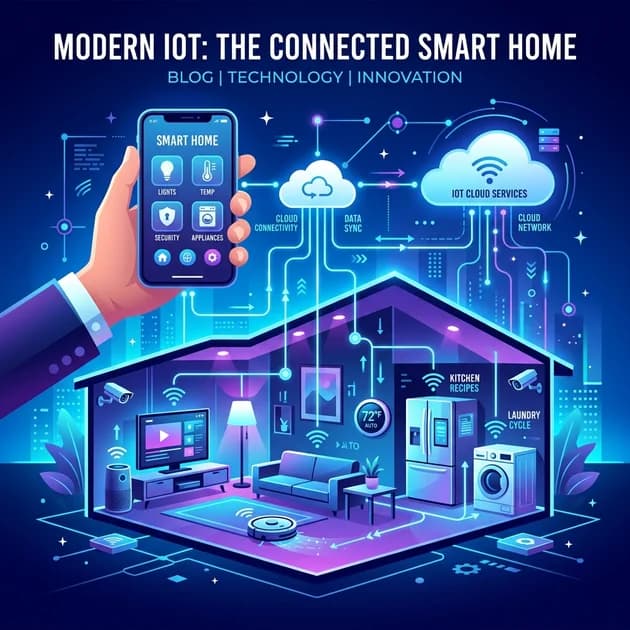
Learn what the Internet of Things (IoT) is, how it works, real-world examples, benefits, challenges, and why IoT is transforming modern life.

 Career Growth
The AI-Native Manager (2026): Hybrid & Automated Teams
Master AI-native management in 2026. Discover how to lead hybrid human-AI teams, delegate operational tasks, govern AI ethically, and build resilient workflows.

Future-Proof Your Career in the Automation Era (2026)
Future-proof your career in 2026. Master durable human skills, AI collaboration, the CARE Model, and actionable roadmaps to thrive in the automation era.