 Technology
How 5G Technology Works and Why It Matters in 2026

Sunil Kumar Uikey
Founder & Editor-in-Chief
Learn how 5G technology works, its benefits, real-world applications, and how it is transforming industries through faster connectivity, IoT, AI, and edge computing.
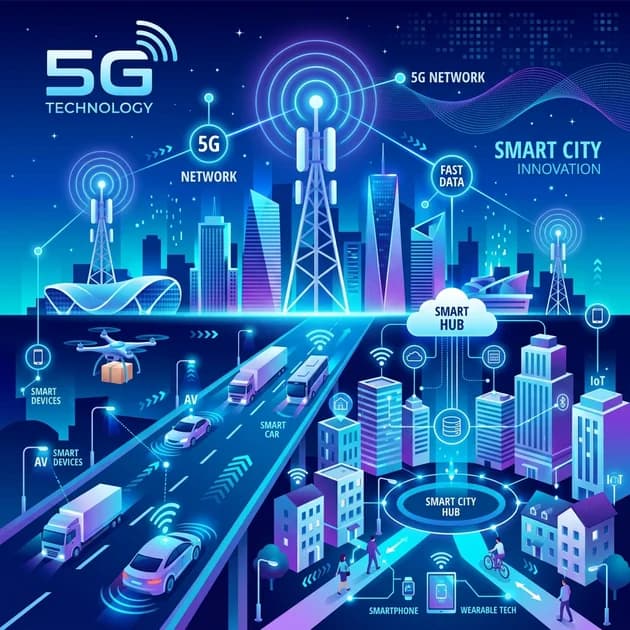
Introduction
For most of the last decade, mobile networks were simply the pipeline used to browse the internet, stream videos, and send messages on our smartphones. When 4G arrived, it provided the bandwidth necessary to make mobile video streaming and ride-sharing apps a reality. However, as our world becomes increasingly digitized, automated, and interconnected, 4G is no longer sufficient.
Welcome to the era of 5G.
5G is not just a faster version of 4G; it is a fundamental reimagining of how wireless communications operate. It is the invisible connective tissue actively making sci-fi concepts—like autonomous transportation, remote robotic surgery, and fully automated Smart Cities—a practical reality. Understanding how 5G works is crucial because it serves as the foundational layer for almost all major technology trends shaping 2026.
In this comprehensive guide, we break down what 5G technology is, the fascinating networking science behind how it works, how its architecture differs from previous generations, and why its global rollout is permanently transforming modern enterprise and society.
Quick Answer
5G Technology represents the fifth generation of wireless networks, designed as the foundational cellular infrastructure for the modern digital economy. It dramatically outpaces previous standards by delivering ultra-low latency, multi-Gigabit high-speed connectivity, and massive device connectivity. This allows millions of sensors, autonomous vehicles, and industrial machines to communicate simultaneously. By prioritizing real-time communications and Edge Computing integration, 5G moves beyond simple mobile broadband to power everything from smart factories to mission-critical remote healthcare operations.
Key Takeaways
- Architectural Shift: 5G moves beyond simple smartphone connectivity, acting as the foundational infrastructure for industrial automation and smart cities.
- Ultra-Low Latency: 5G reduces response times to near-zero (approx. 1 millisecond), making real-time applications like remote surgery and autonomous driving safe and viable.
- Massive Device Capacity: It can support up to 1 million connected devices per square kilometer, eliminating network congestion in dense urban areas.
- Network Slicing: Operators can create multiple virtual networks on a single physical 5G network, customizing speed and security for specific enterprise use cases.
- Ecosystem Enabler: 5G does not work alone; it is the vital wireless pipeline that allows Edge Computing and IoT to function at scale.
- Enterprise Focused (Private 5G): Businesses are deploying their own localized "Private 5G" networks to secure manufacturing plants, ports, and corporate campuses.
Why 5G Matters in 2026
5G matters today because it is no longer just about faster mobile downloads; it is the enabling infrastructure of the modern digital economy.
As organizations exponentially increase their use of connected devices, cloud services, and artificial intelligence, the physical limitations of older networks create a severe bottleneck. 5G solves this bottleneck. It provides the massive bandwidth required for industrial automation, the low latency needed for smart infrastructure, and the massive capacity required for the global expansion of IoT. Without 5G, the advanced real-time applications defining the next decade of technology simply cannot function reliably.
How We Explain 5G
Telecommunications infrastructure is inherently complex, involving advanced physics and intricate networking standards. This guide simplifies those concepts using practical examples, current industry practices, and widely accepted networking principles.
Drawing on frameworks established by the 3rd Generation Partnership Project (3GPP)—the consortium that develops global 5G specifications—and the International Telecommunication Union (ITU), we maintain strict editorial neutrality. We focus on how the technology works practically, cutting through marketing jargon to provide clear, accurate, and actionable educational insights.
What Is 5G Technology?
Simply put, 5G is the fifth generation of cellular network technology. It is a new global wireless standard designed to connect machines, objects, and devices dynamically.
To understand why 5G is fundamentally different, we must examine the evolution of cellular generations, as each generation was built to solve a completely different problem:
- 1G (1980s): Built for analog voice calls. It proved true mobile communication was possible.
- 2G (1990s): Introduced digital voice calls and basic text messaging (SMS). It proved data could be digitized.
- 3G (2000s): Brought the core internet to mobile phones, allowing for basic web browsing and email.
- 4G LTE (2010s): Ushered in the era of mobile broadband, enabling high-quality video streaming and the modern app-based gig economy.
4G was built to connect people to the internet. 5G is architecturally different because it was built from the ground up to connect machines to machines. It is engineered to deliver multi-Gigabit speeds, ultra-low latency, and massive network capacity to handle automated, non-human digital traffic seamlessly.
How 5G Works: The Core Technologies
To achieve its record-breaking capabilities, 5G relies on a combination of new physics and upgraded network architectures.
The 5G Network Architecture Diagram
[Connected Devices]
        │
        ▼
[5G Radio (Small Cell)]
        │
        ▼
[Massive MIMO + Beamforming]
        │
        ▼
[5G Core Network]
        │
        ▼
[Edge Computing]
        │
        ▼
[Cloud Platform]
        │
        ▼
[Enterprise & Consumer Applications]
The Six Core Technologies Behind 5G
To build this architecture, telecommunications leaders like Ericsson, Nokia, and Qualcomm rely on six fundamental technological pillars:
1. Millimeter Wave (mmWave)
The ultra-high-frequency spectrum (24 GHz to 100 GHz). While it cannot travel far and is easily blocked by obstacles, it acts as a massive multi-lane data highway. Practical Example: Providing flawless, ultra-high-capacity wireless broadband inside crowded sports stadiums where tens of thousands of users are streaming simultaneously.
2. Sub-6 GHz Spectrum
The workhorse frequencies of 5G networks. Sub-6 GHz provides an optimal balance between fast data speeds and wide geographic coverage, easily penetrating buildings. Practical Example: Providing reliable, city-wide mobile broadband coverage for millions of daily smartphone users and municipal sensors.
3. Massive MIMO
MIMO stands for Multiple Input, Multiple Output. Traditional 4G cell towers have a few antennas. 5G base stations use Massive MIMO arrays, containing a hundred or more antennas on a single tower to handle vast amounts of traffic simultaneously. Practical Example: Ensuring a dense smart city district with millions of IoT sensors does not overwhelm the local cell tower.
4. Beamforming
To prevent signals from crossing paths and causing interference, 5G uses beamforming. Instead of broadcasting a signal in all directions (like a lightbulb), beamforming calculates the most efficient route and focuses the signal directly to the specific user (like a laser pointer). Practical Example: Sustaining a high-speed video stream on a rapidly moving autonomous vehicle seamlessly transitioning between different cell towers.
5. Network Slicing
Allows operators to slice a single physical 5G network into multiple virtual networks, each optimized for different speed, security, and latency requirements. Practical Example: Slicing the network so a hospital's remote robotic surgery data is prioritized with ultra-low latency, kept entirely isolated from public internet browsing.
6. Standalone (SA) Core
Early 5G (Non-Standalone or NSA) bolted new radios onto older 4G core networks. True 5G requires Standalone (SA) architecture, featuring a completely modernized core network to unlock ultra-low latency and advanced routing. Practical Example: Enabling true industrial automation where machines communicate instantly without being bottlenecked by legacy 4G routing paths.
Standards Behind Modern 5G
The global interoperability of 5G is not accidental. It is governed by strict international standards set by organizations like the 3rd Generation Partnership Project (3GPP) and the International Telecommunication Union (ITU) through their IMT-2020 vision.
- 3GPP Releases: The evolving specifications for 5G (e.g., Release 15 launched 5G, Release 18 introduces 5G Advanced).
- ITU IMT-2020: The overarching performance requirements dictating what officially qualifies as a 5G network.
- Open RAN (Radio Access Network): A movement to use open software standards, allowing carriers to mix hardware from different vendors rather than relying entirely on proprietary ecosystems from a single provider like Cisco or Samsung.
- Multi-access Edge Computing (MEC): Brings computational power directly to the edge of the mobile network, drastically reducing latency by not sending data back to a centralized cloud.
- Private 5G: Dedicated, localized cellular networks built entirely for a single enterprise, bypassing public carrier traffic.
- Network Function Virtualization (NFV): Replacing expensive, dedicated hardware appliances (like firewalls) with software running on standard servers.
- Software-Defined Networking (SDN): Centralizing the control of the network via software to dynamically route traffic based on real-time demand.
Understanding 5G Spectrum Bands
Understanding how 5G covers a country requires looking at the spectrum it uses. Different frequencies serve entirely different purposes.
| Band | Coverage | Speed | Best Use Cases |
|---|---|---|---|
| Low Band (Under 1 GHz) | Excellent (Penetrates buildings, travels far) | Moderate (Better than 4G) | Rural coverage and deep indoor connectivity |
| Mid Band (1 GHz – 6 GHz) | Very Good (Balanced range) | High (Hundreds of Mbps) | City-wide coverage and suburban business districts |
| mmWave (24 GHz+) | Limited (Easily blocked, short range) | Extremely High (Multi-Gigabit) | Stadiums, dense smart factories, and urban core hotspots |
5G vs 4G: Key Differences
To truly understand the leap forward, we must compare 5G's capabilities directly against the previous 4G LTE standard.
| Feature | 4G LTE | 5G Technology |
|---|---|---|
| Peak Speed | Up to 1 Gbps | Up to 10-20 Gbps (10x to 20x faster) |
| Average Latency | ~50 milliseconds | ~1 millisecond (50x lower delay) |
| Device Capacity | ~100,000 devices per sq. km | ~1,000,000 devices per sq. km (10x more) |
| Spectrum Used | Sub-3 GHz (crowded) | Sub-3 GHz, plus high-frequency mmWave |
| Network Intelligence | Basic routing | Advanced routing (Network Slicing, Beamforming) |
| IoT Capability | Limited (Congests easily) | Massive (Built specifically for sensor scaling) |
| Edge Compatibility | Low (Forced to cloud) | High (Natively integrates with Edge Computing) |
Why These Differences Matter Practically
If you are streaming a movie, 4G is fine. But if you are operating a fleet of autonomous forklifts in a warehouse, 4G's 50-millisecond delay and tendency to drop connections in crowded environments will cause crashes. 5G guarantees that the forklift receives its braking command instantly (low latency), that the connection won't drop even if thousands of other sensors are active (capacity), and that the data is securely separated from public traffic (network slicing).
The 5G Technology Ecosystem
5G does not operate in a vacuum. It is one critical component of a broader, intelligent digital infrastructure connecting smart cities and global enterprise:
[5G Networks]
      │
      ▼
[Internet of Things]
      │
      ▼
[Edge Computing]
      │
      ▼
[Artificial Intelligence]
      │
      ▼
[Cloud Computing]
      │
      ▼
[Smart Cities]
These technologies complement each other entirely. 5G provides the high-speed pipeline. IoT generates the physical data. Edge Computing processes urgent decisions locally. Cloud Computing stores massive datasets globally, and Artificial Intelligence analyzes the data for actionable intelligence.
How Industries Use 5G
| Industry | Primary Applications | Key Benefit |
|---|---|---|
| Manufacturing | Smart Factories | Real-time robotics control and automated quality inspection |
| Healthcare | Remote Surgery & Monitoring | Ultra-low latency for precision robotics and instant data transmission |
| Transportation | Connected Vehicles & Autonomous Driving | Vehicle-to-Everything (V2X) communication for collision avoidance |
| Agriculture | Precision Farming | Real-time soil and drone data for optimized crop yields |
| Retail | Smart Stores & AR Experiences | Frictionless checkout and immersive virtual fitting rooms |
| Energy | Smart Grids & Utilities | Real-time grid balancing and predictive infrastructure maintenance |
| Government | Smart Cities & Public Safety | Intelligent traffic management and prioritized emergency response slicing |
Best Practices for Enterprise 5G Adoption
Transitioning to advanced 5G infrastructure requires rigorous strategic planning for maximum operational impact.
- Network Planning: Conduct thorough site surveys to determine if high-frequency mmWave is viable inside concrete manufacturing plants.
- Private vs Public 5G Evaluation: Determine if your operation requires the absolute control of a Private 5G network or can utilize a dedicated slice of a public network.
- Security by Design: Implement zero-trust Cybersecurity architectures from day one, as every new IoT sensor expands the attack surface.
- Spectrum Strategy: Secure the correct local spectrum licenses if building a standalone private network.
- Edge Integration: Deploy Multi-access Edge Computing (MEC) servers on-site to process critical data locally before it hits the 5G core.
- Cloud Integration: Ensure the 5G core seamlessly routes non-urgent data to central cloud environments for long-term storage and AI training.
- Device Lifecycle Management: Plan for the continuous updating and patching of thousands of connected 5G IoT sensors.
- Real-Time Monitoring: Utilize AI-driven network monitoring to instantly detect and route around interference or hardware failures.
- Regulatory Compliance: Ensure localized data processing complies with regional data sovereignty laws.
- Scalability Planning: Design the network to handle vastly more devices than current capacity to accommodate future digital transformation initiatives.
Enterprise Perspective and Real-World Applications
Private 5G and Campus Networks
Massive shipping ports, automotive plants, and university campuses are shifting away from unreliable Wi-Fi in favor of Private 5G. This gives the enterprise total ownership of the network, preventing public traffic from slowing down critical operations and ensuring absolute data privacy.
Industrial Automation and Robotics
Inside a modern smart factory, miles of copper wiring are being replaced by wireless 5G connections. This allows heavy machinery, robotic arms, and automated guided vehicles (AGVs) to be reconfigured dynamically on the factory floor, driving profound digital transformation.
Edge-Native Applications and Digital Twins
Enterprises are utilizing 5G to power Digital Twins—exact digital replicas of physical assets (like a jet engine). 5G streams thousands of data points per second from the physical engine to the digital twin, allowing AI to predict exact maintenance failures before they happen.
Business Continuity and The Future of Work
5G ensures absolute business continuity by providing high-bandwidth cellular failovers for corporate networks. Furthermore, it is actively reshaping the Future of Work by enabling flawless remote collaboration via immersive spatial computing and high-fidelity virtual reality environments.
Challenges and Concerns About 5G
Despite its transformative potential, the global rollout of 5G faces significant hurdles that require balanced analysis.
Infrastructure Modernization and Cost
Building a 5G network is incredibly expensive. Because mmWave requires small cell networks, telecom companies must install thousands of new antennas and lay thousands of miles of new fiber-optic cables to connect them. This requires massive capital investment.
Spectrum Availability and Regulatory Approvals
Radio spectrum is heavily regulated by governments. Telecoms must spend billions bidding on licenses to use specific 5G frequencies. Furthermore, obtaining local municipal permits to install small cells on city streetlights is notoriously slow and bureaucratic.
Rural Deployment and the Digital Divide
Because high-frequency 5G signals do not travel far, providing true 5G coverage in rural areas is extremely difficult and largely unprofitable for telecoms. Currently, the fastest 5G speeds are confined to dense urban centers, threatening to widen the global digital divide.
Interoperability and Cybersecurity
The massive increase in connected devices expands the potential attack surface for cybercriminals. Securing this network requires strict cybersecurity protocols mandated by organizations like GSMA and ETSI. Getting equipment from different international vendors to interoperate securely remains complex.
The Future Outlook
As we progress through the late 2020s, the evolution of 5G is accelerating toward specialized, intelligent architectures.
Current 5G Landscape
Today, the focus is squarely on Enterprise Private 5G deployments and transitioning public networks from NSA to true SA (Standalone) architectures. Major tech companies are actively integrating 5G with Edge Computing environments to reduce reliance on distant data centers.
Near Future (3–5 Years)
- 5G Advanced (Release 18+): The next iteration of the standard will introduce AI-native networks, where artificial intelligence actively manages network routing and power consumption dynamically.
- Open RAN Mass Adoption: Telecoms will increasingly break away from vendor lock-in, adopting open software standards to build more flexible, cost-effective networks.
- Non-Terrestrial Networks (NTN): Direct-to-cell satellite integration will eliminate dead zones, providing seamless 5G connectivity via Low Earth Orbit (LEO) satellites.
Long-Term Outlook
- Sustainable Wireless Infrastructure: The industry is moving heavily toward zero-emission network operations, utilizing AI to dynamically power down cell towers when traffic is low.
- 6G Research: Standard bodies like the IEEE and the ITU are already deeply invested in 6G. Expected in the 2030s, 6G promises terabits-per-second speeds, potentially enabling flawless holographic communications, massive sensory internet, and deep integration with Quantum Computing.
Frequently Asked Questions
What is 5G technology in simple terms?
5G is the fifth generation of global mobile networks. It is vastly faster than 4G, can connect millions more devices simultaneously, and features near-zero delay (latency), making it the primary infrastructure for advanced technologies like self-driving cars.
What is 5G Advanced?
5G Advanced (starting with 3GPP Release 18) is the next major evolutionary step for 5G. It natively integrates Artificial Intelligence into the network to optimize performance, improves energy efficiency, and greatly enhances precise device positioning capabilities.
What is Open RAN?
Open Radio Access Network (Open RAN) is a movement toward open software standards in telecom hardware. It allows network operators to mix and match components from different vendors, increasing competition and lowering deployment costs.
What is MEC?
Multi-access Edge Computing (MEC) brings cloud computing capabilities directly to the edge of the 5G network (near the cell tower). This allows data to be processed locally in milliseconds rather than traveling hundreds of miles to a central data center.
Can businesses build private 5G networks?
Yes. Enterprises can purchase their own spectrum licenses and hardware to deploy Private 5G networks. This provides a factory or corporate campus with guaranteed speeds, total privacy, and complete control over network security, unimpacted by public cell phone traffic.
Is 5G secure?
5G introduces significant security upgrades over 4G, including enhanced encryption and identity verification. However, because it connects millions of new IoT devices, it vastly expands the potential attack surface, requiring robust zero-trust security architectures.
How does 5G support AI and IoT?
5G acts as the ultra-fast, massive-capacity pipeline. It allows millions of IoT sensors to collect data simultaneously without congesting the network, and delivers that data to AI systems with near-zero latency for instant, automated decision-making.
What careers are available in 5G networking?
The rollout of 5G and future 6G networks drives massive demand for RF (Radio Frequency) engineers, network architects, edge computing specialists, IoT security analysts, and telecom software developers focusing on SDN and NFV infrastructure.
Is 5G available everywhere?
No. While 5G is widely available in major global cities and urban centers, its high-frequency signals do not travel far. Rural and remote areas currently rely heavily on 4G LTE or lower-band, slower versions of 5G.
Can 5G replace fiber internet?
For many homes and businesses, yes. "Fixed Wireless Access" (FWA) uses a 5G receiver on a house to capture high-speed internet from a nearby cell tower, providing speeds comparable to traditional wired fiber-optic cables without needing to dig up the street.
Further Reading
To explore the technical standards and global frameworks guiding modern wireless connectivity, consult these authoritative resources:
- 3GPP (3rd Generation Partnership Project): The consortium responsible for developing the technical specifications for global 5G and 5G Advanced networks.
- ITU (International Telecommunication Union): The United Nations agency guiding the IMT-2020 vision and global spectrum allocation.
- GSMA (Global System for Mobile Communications): Industry organization representing the interests of mobile operators worldwide.
- ETSI (European Telecommunications Standards Institute): Producing globally applicable standards for Information and Communications Technologies.
- IEEE Communications Society: Academic research, standard development, and publications concerning 5G and future 6G technologies.
- Ericsson Mobility Report: Authoritative industry data tracking the global rollout and adoption rates of 5G.
- Nokia Bell Labs: Advanced research covering the future of edge computing, network slicing, and 6G infrastructure.
Final Verdict
5G is the communications backbone of the intelligent digital economy, enabling billions of connected devices, real-time applications, and next-generation services through high-speed, ultra-low-latency wireless networks.
It is far more than a smartphone upgrade. By combining Advanced Radio Technologies, Massive MIMO, Beamforming, Network Slicing, Edge Computing, Cloud Computing, Artificial Intelligence, and IoT, 5G creates a highly resilient digital infrastructure. It is the active architectural framework powering smart industries, autonomous transportation, healthcare innovation, connected infrastructure, and future digital services.
For professionals navigating the shifting technological landscape, understanding 5G as part of a broader digital transformation is essential. To see how these technologies intersect, we highly recommend exploring how decentralized wireless networks combine with Edge Computing, Cloud Computing, Artificial Intelligence, and Cybersecurity.
Related Articles
- Top Technology Trends Shaping 2026
- Edge Computing Explained: What It Is and Why It Matters
- What Is the Internet of Things (IoT)? A Beginner's Guide
- What Is Cloud Computing? A Beginner's Guide
- What Is Cybersecurity? A Complete Beginner's Overview
- Digital Identity Explained: The Future of Verification
- Artificial Intelligence Explained: What It Is and How It Works
- Digital Twins Explained: What They Are and Why They Matter
Enjoyed this article?
Get practical AI tools, technology insights, software reviews, career growth advice, and online income strategies delivered to your inbox.
Keep Reading
Related Articles

What Is Cloud Computing? A Beginner's Guide to How the Cloud Works (2026)
Learn what cloud computing is, how it works, its benefits, types, and real-world examples. A complete beginner-friendly guide for 2026.
What Is the Internet of Things (IoT)? A Beginner's Guide (2026)
Learn what the Internet of Things (IoT) is, how it works, real-world examples, benefits, challenges, and why IoT is transforming modern life.

What Is Cybersecurity? A Beginner's Guide to Staying Safe Online (2026)
Learn what cybersecurity is, why it matters, common cyber threats, and practical ways to protect yourself online. A complete beginner-friendly guide for 2026.
 AI Tools
ChatGPT vs Gemini in 2026: The Ultimate AI Showdown
An in-depth, technical comparison of ChatGPT vs Gemini in 2026. We break down their reasoning engines, ecosystem integrations, and which AI you should actually pay for.

 Software Reviews
Ahrefs vs Semrush (2026): Which SEO Tool Is Better?
Compare Ahrefs vs Semrush in 2026. Review verified pricing, credit limits, daily quotas, backlink discovery, keyword research, and buyer recommendations.

 Career Growth
The AI-Native Manager (2026): Hybrid & Automated Teams
Master AI-native management in 2026. Discover how to lead hybrid human-AI teams, delegate operational tasks, govern AI ethically, and build resilient workflows.